Subscribe

RSS Feed (xml)

Powered By

Skin Design:
Free Blogger Skins

Powered by Blogger

Showing posts with label CLASSIC HORROR MOVIE. Show all posts

Sunday, March 2, 2008

Cannibal Holocaust (Full movie!)

This is the urban legendary 1980 horror film, that the public believed to depicture real homicides

In the beginning of this film we meet a documentary team of three young men and a young woman. They are heading for the south-American jungle to search for real cannibals. After a while the crew is reported missing and a rescue team is send from the US. This team gets in touch with an amazon tribe called the Tree-people. The tree-people gives them the only remains of the first crew - the film rolls containing the material this crew shot during their search for real cannibals. Back in the US we get to see these films. We now get to see exactly what happened to the first crew


TRIVIA
The film caused some scandal in Italy at the time of its release. Ten days after premiering in Milan, the film was seized by the courts, and the director, Ruggero Deodato, was arrested and charged with obscenity. He was later charged with murder and faced life in prison on the belief that several of the actors were murdered for the camera. Deodato contacted Luca Barbareschi and told him to contact the three other actors who played the missing film team. He presented the actors, alive and well, to the courts, and thus, the murder charges were dropped. The film remained banned in Italy for another three years.

The animal slaughterings in the movie were real, which ultimately resulted in the movie's being banned in its native Italy after the snuff film rumors were proved false. The killed animals were a coatimundi (erroneously referred to as a muskrat in the film), a turtle, a snake, a tarantula, a spider monkey, and a pig.

The in-film-documentary, "The Last Road To Hell", which features several executions, consists of authentic footage supposedly from Nigeria and South East Asia.

Deodato was inspired to make the movie after seeing his son watching the violent news on TV and noticed how the journalists focus on the violence. He also believed that some news angles were actually staged to capture more sensational footage, hence the similar angle seen in the film.

This movie has gained the title of the most notorious movie of all-time, and is often claimed to be banned in over 50 countries worldwide. If true, it would easily hold the world record for the most heavily banned film.

Deodato wanted a scene in which the natives fed an enemy tribesman to piranhas but he didn't have a working underwater camera. Only still shots of that scene exist.

The iconic image for the film shows a "cannibal" girl impaled on a stick. Upon being summoned to court in order to assert that no actors were harmed during production, Deodato explained that the girl simply sat on a bicycle seat attached to the pole's base, while holding a small pointed balsa wood piece in her mouth. The fake blood was then added. Deodato commented that the girl had an unusually calm temperament to be able to remain so still during the filming.

According to a 2005 interview with Carl Gabriel Yorke (Alan Yates), Yorke said that when rehearsing for the sex scene with Francesca Ciardi (Faye Daniels), she suggested that the two go out in the middle of the jungle and "actually do it". Yorke declined, stating that he was with somebody back in New York. As a result, Ciardi was very upset with him during the entire shoot

When Carl Gabriel Yorke (Alan Yates) arrived in the Amazon for shooting, he wasn't given a script or an idea of what the movie was about. As soon as he arrived, director Ruggero Deodato shouted "That's my star! Get him into makeup!" Almost immediately, the first scene they shot was the amputation of one of the character's leg. Yorke later in an interview said while staying there in the jungle, he didn't know whether this film was a Hollywood production or simply a snuff film.

A large advertisement for Dracula (1979) is visible in the opening shots of the streets of New York City.

Immediately after a pig was shot and killed in the movie, Carl Gabriel Yorke botched a long monologue Deodato very much wanted to be included in the movie. After rehearsing the line several times and doing fine, Yorke says he screwed up during filming because he heard the pig squeal and die. Retakes weren't possible because they had no access to any more pigs, which they would only use to shoot and kill.

Originally, Deodato had a fake monkey head with fake brains in it to have the natives eat instead of actually killing and eating a monkey. The natives talked him out of it, however, as monkey brains were a delicacy to them.

The pistol used by Robert Kerman in the movie was a Smith and Wesson .32

Director Cameo: [Ruggero Deodato] A man sitting on a blanket outside of the NYU university.

The scene where an actor kills a monkey was shot twice, so two monkeys were killed for that scene.

Though uncaring towards the nature of his film during shooting, Ruggero Deodato now regrets everything he did, mostly the actual animal killings. He said once that he wishes now that he never made the movie.

Robert Kerman's character had to be dubbed, but all other actors' real voices were used.

Claims of this being a snuff film are still rampant. Even as recently as 1993, authorities at a Birmingham comic fair seized the film on this belief.

There have been six unofficial sequels to Cannibal Holocaust. Natura contro (1988) was There have been six unofficial sequels to Cannibal Holocaust. Natura contro (1988) was the first movie to call itself Cannibal Holocaust II (in Italy, Turkey, and the UK). Other movies that tried to incorporate themselves with Cannibal Holocaust were Schiave bianche: violenza in Amazzonia (1985) (Cannibal Holocaust 2: The Catherine Miles Story on European DVD), Mangiati vivi! (1980) (Cannibal Holocausto 2 on Argentinian DVD), Mondo cannibale (2003) (V) (known as Cannibal Holocaust 2: The Beginning in Japan), and Nella terra dei cannibali (2003) (V) (also known as Cannibal Holocaust 3: Cannibal vs. Commando in Japan). If all these movies were considered actual sequels, Cannibal Holocaust would have four "part two"s in its series.

Second part of Ruggero Deodato's "Cannibal Trilogy" also including Ultimo mondo cannibale (1977) and Inferno in diretta (1985).

The turtle killed in the turtle killing scene was a Yellow-spotted river turtle or Podocnemis unifilis.

In ten days after its release, the movie grossed what would be about $5 million dollars today (approximately $1.9 million in February 1980) before the film was seized by the courts and Deodato arrested. Because of its infamy and several subsequent re-releases, it is claimed that the film has grossed $200 million worldwide (inflation not adjusted), though this has never been verified.

Despite his character's behavior during filming, Perry Pirkanen cried after filming the infamous turtle scene.

Cannibal Holocaust (1980) was the second highest grossing film in Japan in 1983, behind only E.T.: The Extra-Terrestrial (1982).

A small segment of music from Non si sevizia un paperino (1972) was reused by Riz Ortolani in this film.

The actresses used in the scene in which the professor bathes naked in a river were hired from a local brothel.

The actress in the adulteress punishment was actually the head of wardrobe, Lucia Costantini. Apparently, the production team was unable to find any local women to agree to be in the seen. Costantini was completely covered in mud to give the appearance that she was a native.

The father of the actor who played Miguel was murdered during filming. Production was delayed slightly as the actor went home for the funeral. He can be seen crying over his father's death in the scene in which Professor Monroe, Chaco, and Miguel are sitting outside the Yanomamo village immediately following the discovery of the bone shrine.

The tribe names in the film, Yanomamo and Shamatari, are actual native tribes in South America. Neither tribe is accurately portrayed in the film.

CAMP BLOOD 2

Back to Camp Blood they go. Lots of hate and hacking. Revenge can be messy. Will anyone make it out of Camp Blood alive?


Saturday, November 17, 2007

EEGAH ! 1962

Archie Hall was a supporting actor in B-movies and westerns for over 20 years before opening his ... all » own film production company. He produced one nudie cutie before deciding his 19-year-old son, Arch Jr., was star material and started building a career around him.

Now known as Arch Hall, Senior, he wrote, produced, and directed the movie 'Eegah' under the pseudonym of Nicholas Merriwether, played a sizeable supporting role under the name William Watters, put Arch Jr. in the lead, and drafted his own office secretary, Marilyn Manning, to play the female lead. Archie's wife, Addalyn Pollitt, has a two-line bit part in the last reel.

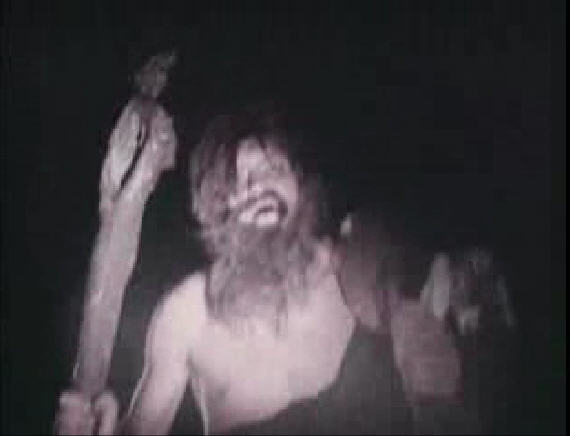
Only Richard Kiel, playing the prehistoric title character, had no previous ties with Arch Senior. His portrayal of Eegah is one of the most sympathetic monsters you're ever going to meet.

Arch Jr. not only gets to show off his acting prowess, but also gets to sing three tunes (About girls named 'Vicki' and 'Valerie', though his girlfriend's name is Roxy.) Daddy was grooming him to be a rock n' roll star, too.

Infamous goofs include quoting a verse of the Bible that doesn't exist, in the intended-to-be-profound epilogue.

What we end up with is a drive-in classic that's a lot more fun than it intended to be.

Elvira Midnight Madness Eegah Intro


Eegah Movie

Sunday, October 7, 2007

CLOCKWORK ORANGE


Alex (Malcolm McDowell) has his own way of having a good time. He has it at the tragic expense of others. Alex's journey from amoral punk to brainwashed proper citizen forms the dynamic arc of Stanley Kubrick's future-shook vision of Anthony Burgess's novel. Unforgettable images, startling musical counterpoints, the fascinating language used by Alex and his pals - Kubrick shapes them into a shattering whole. Hugely controversial when first released, A Clockwork Orange won the New York Film Critics Best Picture and Director honors and earned four Academy Award nominations, including Best Picture. The power of its art is such that it still entices, shocks, and holds us in its grasp.
1972


CLICK HERE TO WATCH MOVIE


TRIVIA

Rated #2 of the 25 most controversial movies of all time. Entertainment Weekly, 16 June 2006.

Kubrick had his assistant destroy all unused footage

The Car used by Alex and the droogs was the "Adams Probe 16", one of three ever made.

Premiere voted this movie as one of "The 25 Most Dangerous Movies".

In the music shop scene there is a list of Top Ten music bands up on the wall. One of the bands listed is Heaven Seventeen, which one of the girls mentions to Alex. This name was used by a real band in the 80's.

In 2007, the American Film Institute ranked this as the #70 Greatest Movie of All Time.

Contrary to popular claims, this film was never banned in the UK. It originally received an "X" rating in 1971 and was withdrawn from distribution in 1973 by the film's director. In 1999 (the year of Stanley Kubrick's death), the film was released again and received an "18" rating.

The writer of the book, 'Anthony Burgess' , lived for a time in Malaysia [where his wife was beaten by four American GI's, thus giving inspiration to this story]. In Malay, the word "orang" means man,[this is also part of the derivation of the word 'orangutan', the other half being derived from "hutan" meaning jungle] therefore, the title of the story is actually a pun on the British expression. Rather than a clockwork fruit, it is a clockwork man, which is, of course, exactly what Alex has become by the end of the film.

The title was translated into Serbo-Croatian as "The Orange From Hell" ("Paklena Naranca" - Croatian, "Paklena Pomorandza" - Serbian). This comes from the term for clockwork bombs - "Paklena Masina" - "Machine from hell"

In the early 1990's London's popular Scala Film Club showed this movie without permission from Stanley Kubrick or Warner Brothers. At Kubrick's insistence Warners sued and won. As a result the Scala was almost bankrupt and closed in 1993.

Much of the continuity errors in this film (glass placement in the dinner scene, Alex's droog's hats appearing/disappearing at the river, etc.) were all intentional. Stanley Kubrick was trying to have a slight disorienting effect in this film.

The combination to Alex's bedroom door is 17-34-89

In the scene where Reformed Alex is being taken into the woods by his old droogan buddies you can see the officer numbers on their uniforms 665 and 667 implying that Alex is 666.

The doorbell at the Alexander residence, "Home", plays the first four notes of Ludwig van Beethoven's "Fifth Symphony" (but in a different key).

At one point, Tinto Brass was attached to direct.

"Korova" is Russian for "Cow", hence the name "The Korova Milk Bar."

The word "Moloko" on the walls of the milk bar means milk in Russian.

Alex's prison number in the movie is 655321. "Six, double five, three, two, one." However in the book his prison number is 6655321.

Ken Russell was considered to direct the movie, with Oliver Reed playing the part of Alex.

MORE TRIVIA ON IMBD.COM

THE MONSTER

Georges Méliès - The Monster (1903)

This is the earliest known monster movie. It is a silent movie short set in Egypt. An Egyptian prince has lost his beloved wife and he has sought a dervish who dwells at the base of the sphinx. The prince promises him a vast fortune if the dervish will only give him the opportunity of gazing once more upon the features of his wife. The dervish accepts the offer. He brings in from a neighboring tomb the receptacle containing the remains of the princess. He opens it and removes the skeleton, which he places upon the ground close beside him. Then, turning to the moon and raising his arms outstretched toward it, he invokes the moon to give back life to her who is no more. The skeleton begins to move about, becomes animated, and arises. The dervish puts it upon a bench and covers it with a white linen; a masque conceals its ghostly face. At a second invocation the skeleton begins again to move, arises, and performs a weird dance. In performing its contortions it partly disappears in the ground. While performing its feats it increases gradually in size, its neck assuming enormous proportions, much to the horror of the prince, who fails to see in this grotesque character the wife whom he has lost. The dance ceases. The dervish throws a veil over the hideous creature. Then appear the real princess as she was when her husband possessed her. The prince darts forward to take her into his arms to give her a last kiss, but the dervish stops him, wraps the young lady in the veil and throws her into the arms of the prince. When he removes the veil he finds only the skeleton of his former wife. The vision has disappeared, and the princess has returned to dust. The dervish withdraws, and the prince pursues him with his threats and curses.


Online Videos by Veoh.com

DAY OF THE TRIFFIDS


DAY OF THE TRIFFIDS
1963

A shower of meteorites produces a glow that blinds anyone that looks at it. As it was such a beautiful sight, most people were watching, and as a consequence, 99% of the population go blind. This chaos results in the escape of some Triffids: experimental plants that are capable of moving themselves around and attacking people

CLICK HERE TO WATCH THE MOVIE

TRIVIA
The triffids inspired the E.T. plants of _E.T. the Extra-Terrestrial (1982)_ .

When the film was finished it was too short, so the entire sequence where the triffids attack the lighthouse was added.

Although credited with "additional music", composer Johnny Douglas actually supplied more music than the main composer, Ron Goodwin. According to the official music cue sheets, Douglas wrote 26 mins, Goodwin 19 minutes

Triffids are referenced in the opening number of the stage/film musical The Rocky Horror Picture Show: "I really got hot when I saw Janette Scott fight a triffid that spits poison and kills." Janette Scott played the role of Karen Goodwin in the 1962 film adaptation.

The Triffids is also the name of an Australian rock group from the 1980s.

In the computer game Darwinia there is an immobile enemy unit called a triffid that looks like a flower and spits dangerous seeds.

The film 28 Days Later features several nods to The Day of the Triffids, including the protagonist awakening in a deserted hospital, finding other survivors by following tower lights, and encountering a paramilitary group in a country house whose plans include the acquisition of women with whom to repopulate the country.

The band Gorillaz have a reference to a triffid on the band's official website. Upon further inspection of band member Murdoc's trailer in the Kong Studio parking garage, you'll find a triffid as a potted plant. When you place your cursor over it, it makes a strange noise and the subtext states, "Absolutely Triffid".

The band Ash have a song titled "Day of the Triffids" on their album Trailer.


The game Kingdom of Loathing has a triffid as an enemy encounter in "The Spooky Forest."

In the Area 52 sequence of Looney Tunes Back in Action, a Triffid can be seen among the aliens housed there.

Episode 6 of the anime series Princess Resurrection (Kaibutsu Oujo) features a walking plant named a Triffid. It has many differences from those in the book, however.

In the computer game Star Control II, a Supox captain is named "Trifid".

In the Marvel comic "New Universal" #1 one of the main characters references The Day of the Trifids saying "Bright light in the sky.Everyone looks. In the morning everyone who looks is blind then, big walking plants sting all the blind people to death.The end."

OASIS OF THE ZOMBIE


1981

An expedition searching for treasure supposedly buried by the German army in the African desert during WW II comes up against an army of Nazi zombies guarding the fortune. Robert tells his story to a German treasure hunter named Kurt, who promptly murders him. Robert's son, upon learning of his father's death, vows to travel to Africa and find the lost gold himself. While the desert is hazardous enough by itself, the dangers lurking around this oasis are more than any of the treasure hunters ever imagined.


CLICK HERE TO WATCH THE MOVIE

THE SHINING


THE SHINING 2 hr 23 min 45 sec
Jack Torrance gets a job as the custodian of the Overlook Hotel, in the mountains of Colorado. The place is closed down during winter, Torrance and his family will be the only occupants of the hotel for a long while. When the snow storms block the Torrance family in the hotel, Jack's son Danny, who has some clairvoyance and telepathy powers, discovers that the hotel is haunted and that the spirits are slowly driving Jack crazy. When Jack meets the ghost of Mr. Grady, the former custodian of the hotel who murdered his wife and his two daughters, things begin to get really nasty.

WATCH THE SHINING

SHINING TRIVIA ON IMDB.COM

THE FINAL TERROR


THE FINAL TERROR 1983
This terrifying movie takes place out in the backwoods where a group of rangers go camping. But when one of the group snaps, and leaves one by one some of the group disappears. It is left up to the rest of the group to defend themselves against this evil. With the killer disguised as the forest surroundings, one of their group held hostage, and a terrifying attack on their tour bus leaving it incapable of travel and one of them with a major injury they have to turn the tables on the killer


WATCH - PART 1 PART 2 PART 3

FUNERAL HOME


FUNERAL HOME 1982
An old funeral parlor now converted into a tourist home during certain periods such as the summer, develops a problem, when a escaped mental patient with a split personality moves in and proceeds to do away with those specific/certain guests or staff, he/she feels are nosy or immoral.


WATCH - PART 1 PART 2 PART 3

Friday, October 5, 2007

NOSFERATU


NOSFERATU

An unauthorized production of Bram Stoker's work (The legal heirs didn't give their permission), so the names had to be changed. But this wasn't enough: The widow of Bram Stoker won two lawsuits (1924 and 1929) in which she demanded the destruction of all copies of the movie, however happily copies of it were already too widespread to destroy them all. Later, the Universal studios could break her resistance against this movie. Count Orlok's move to Wisburg (Obviously the real "Wismar") brings the plague traceable to his dealings with the Realtor Thomas Hutter, and the Count's obsession with Hutter's wife, Ellen the only one with the power to end the evil. Written by Denise Stickel (Corrected by Hauke Hagenhoff)

WATCH NOSFERATU ON GOOGLE VIDEO

One of the best vampire blogs on the net TALIESIN MEETS THE VAMPIRES Check it out

Some Music To set The Mood

Blue Oyster Cult - Nosferatu - I Love The Night
Beautiful, dark music from BOC


Blue Oyster Cult Nosferatu
F.W. Murnau's classic imagery, with a little of the movies history


SOME TRIVIA

The character Orlok is never seen blinking on screen.

Filmed between August and October 1921.

Many scenes featuring Graf Orlok were filmed during the day, and when viewed in black and white, this becomes extremely obvious. This potential blooper is corrected when the "official" versions of the movie are tinted blue to represent night.

Ruth Landshoff, the actress who played the hero's sister once described a scene in which she fled the vampire, running along a beach. That scene is not in any version of the film.

The character of Nosferatu is only seen on screen for a bit less than nine minutes in total throughout the whole film.

All known prints and negatives were destroyed under the terms of settlement of a lawsuit by Bram Stoker's widow. However, the film would subsequently surface in other countries.

The only complete, original copy is said to be owned by the German Max Schreck collector Jens Geutebrück.

Director F.W. Murnau found Max Schreck "strikingly ugly" in real life and decided the vampire makeup would suffice with just pointy ears and false teeth.

The creature that they say is a werewolf, during the scene at the Inn, is actually a Hyena.

Gustav von Wangenheim was not director F.W. Murnau's first or even his second choice, but his third one.

The movie was banned in Sweden due to excessive horror. The ban was finally lifted in 1972

Still, after 85 years, virtually all of the exteriors are left intact in the cities of Wismar and Lubeck.

There have been different first names for the main characters in different English versions. In a few, Hutter is called "Thomas", in others is "Jonathon". Although Hutter's wife is credited as "Ellen", in some versions she is called "Nina".

CHECK OUT THE FACTS ON WIKIPEDIA


DRACULA


At Walpurgis Night, after a harrowing ride through the Carpathian mountains in eastern Europe, Renfield enters castle Dracula to finalize the transferral of Carfax Abbey in London to Count Dracula, who is in actuality a vampire. Renfield is drugged by the eerily hypnotic count, and turned into one of his thralls, protecting him during his sea voyage to London. After sucking the blood and turning the young Lucy Weston into a vampire, Dracula turns his attention to her friend Mina Seward, daughter of Dr. Jack Seward who then calls in a specialist, Dr. Abraham Van Helsing, to diagnose the sudden deterioration of Mina's health. Van Helsing, realizing that Dracula is indeed a vampire, tries to prepare Mina's fiance, John Harker, and Dr. Seward for what is to come and the measures that will have to be taken to prevent Mina from becoming one of the undead. 1931 B/W

CLICK TO WATCH DRACULA

TRIVIA
Universal Studios commissioned a new musical score from composer Philip Glass. It premiered at The Brooklyn Academy of Music on 26 October 1999.

The role of Dracula was originally meant for Lon Chaney.

A Spanish-language version, Drácula (1931/I), was filmed at night on the same set at the same time, with Spanish-speaking actors.

The original plan was to make a big-budget adaptation of "Dracula" that would adhere strictly to Bram Stoker's novel. However, with the Great Depression, Universal didn't have the money to make such a sprawling film. Instead, they opted to adapt the much less expensive Hamilton Deane stage play.

Universal acquired the film rights to "Dracula" from Stoker's widow and the play's writer Hamilton Deane for $40,000.

Before he was cast as Count Dracula, actor Bela Lugosi acted as an unpaid intermediary for Universal Pictures in negotiating with the widow of author Bram Stoker in an attempt to persuade her to lower her asking price for the filming rights to the Dracula property. After two months of negotiations, Mrs. Stoker reportedly lowered her price from $200,000 to $60,000. This, however, further demonstrated to Universal how desperate Lugosi was to repeat his stage success as Count Dracula and secure the film role for himself.

Cinematographer Karl Freund achieved the effect of Dracula's hypnotic stare by aiming two pencil-spot-lights into actor Bela Lugosi's eyes.

The Royal Albert Hall sequence of the movie was filmed on the same stage where The Phantom of the Opera (1925) had been filmed.

The large, expansive sets built for the Transylvania castle and Carfax Abbey sequences remained standing after filming was completed, and were used by Universal Pictures for many other movies for over a decade.

Among the other actors mentioned as possible candidates for the role of Count Dracula were John Wray, Paul Muni, Conrad Veidt, Chester Morris, and William Courtenay.

Bela Lugosi was so desperate to repeat his stage success and play the Count Dracula role for the film version, that he agreed to a contract paying him $500 per week for a seven week shooting schedule, an insultingly small amount even during the days of the Depression.

The spider webs in Dracula's castle were created by shooting rubber cement from a rotary gun.

Bela Lugosi played the role of Dracula on Broadway in 1927 before touring the country with the show. The American performance of the British stage actor Hamilton Deane's adaptation of the book was a smashing success. Soon after the play began touring Universal started to express interest in the script.

Due to studio demands to cut costs, the film was shot in sequence.

When this film was re-released after the Production Code, several deletions were ordered made to the soundtrack. The deletions include Renfield's scream as he is being killed and Dracula's moan as the stake is driven through his heart. These deletions have been restored.

As was done for Frankenstein (1931), the original release featured a prologue introduction with Edward Van Sloan. This prologue was removed for the 1936 re-release. This footage is now assumed to be lost.

After the death of Lon Chaney, one of the first actors considered for the title role was Ian Keith.

While it is rumored thatBela Lugosi, could not speak English very well, and had to learn his lines phonetically, this is not true. Lugosi was speaking English as well as he ever would by the time this was filmed.

The studio did not want the scene where Dracula attacks Renfield to be filmed due to the perceived gay subtext of the situation. A memo was sent to the director stating "Dracula is only to attack women".

There was no real musical soundtrack in the film because it was believed that, with sound being such a recent innovation in films, the audience would not accept hearing music in a scene if there was no explanation for it being there (e.g., the orchestra playing off camera when Dracula meets Mina at the theatre).

Several famous elements often associated with Dracula are not visible in this film. At no point does Dracula display fangs. Also, the famous vampire bite mark on the neck is never shown either (though it is visible in the Spanish version).

Bela Lugosi played Dracula only once more on screen, in the comedy Bud Abbott Lou Costello Meet Frankenstein (1948).

This Universal production became the most famous and successful film to pair David Manners with Helen Chandler. The pair had made two films at Warner Brothers/First National and one at Fox.

The peasants inside the inn are praying The Lord's Prayer in Hungarian.

Bette Davis (who had a contract at Universal at the time) was considered to play the part of Mina Harker. However, Universal head Carl Laemmle Jr. didn't think too highly of her sex appeal.

The opening music to this film is from Act 2 of Swan Lake.

In the scene where Dracula and Renfield are traveling to London by boat, the footage shown is from a Universal silent film called The Storm Breaker (1925).

Although he lived for 67 years after the film was released, David Manners (John Harker) never watched it.

In the first scene, the young woman reading from the tourist book was played by Carla Laemmle. Her uncle was Carl Laemmle, the founder and head of Universal Pictures.

When Carl Laemmle moved Universal to California in 1914, a version of "Dracula" was one of the first projects being considered. It was over fifteen years before this version was produced.

The movie's line "Listen to them. Children of the night. What music they make." was voted as the #83 movie quote by the American Film Institute (out of 100).

When Bela Lugosi died in 1956, he was buried wearing the black silk cape he wore for this film.

Dracula's Picture was stolen from the NEATO COOLVILLE - MONSTERVILLE picture set on flicker. NEATO COOLVILLE is a kick ass blog check it out!

FRANKENSTIEN


Frankenstein; or, The Modern Prometheus is an 1818 novel written by Mary Shelley at the age of 19, first published anonymously in London, but more often known by the revised third edition of 1831 under her own name. It is a novel infused with some elements of the Gothic novel and the Romantic movement. It was also a warning against the "over-reaching" of modern man and the Industrial Revolution, alluded to in the novel's subtitle, The Modern Prometheus. The story has had an influence across literature and popular culture and spawned a complete genre of horror stories and films. Many distinguished authors, such as Brian Aldiss, consider this the very first science fiction novel.

The link to frankenstien is not working, here are a few movies to watch instead

LADY FRANKENSTEIN

THE FIRST FRAKENSTIEN MOVIE 1910 by the Thomas Edison Company

Plus

THE SHE BEAST 1966

JACK AND THE BEANSTALK ABBOTT & COSTELLO's Version 1952

8 HORROR CLASSICS


INVADERS FROM MARS 1953

THEY CAME FROM BEYOND SPACE

THEM 1954

ITS THE TERROR FROM BEYOND SPACE

THE THING FROM ANOTHER WORLD

ATTACK OF THE 50 FOOT WOMAN

THE DEADLY MANTIS

THE ROCKY HORROR PUNK SHOW

THE WAR OF THE WORLDS (animation)

You have seen the others, now SEE the orignal 1938 radio play filmed in SUPER ANIMATION, featuring the voices of Orson Welles and The Mercury Theatre On The Air.

THE SHINING


146 min/1980
A man, his son and wife become the winter caretakers of an isolated hotel where Danny, the son, sees disturbing visions of the hotel's past using a telepathic gift known as "The Shining". The father, Jack Torrance, is underway in a writing project when he slowly slips into insanity as a result of cabin fever and former guests of the hotels ghost's. After being convinced by a waiter's ghost to "correct" the family, Jack goes completely insane. The only thing that can save Danny and his mother is "The Shining".

CLICK HERE TO WATCH THE MOVIE

TRIVIA

During the making of the movie, Stanley Kubrick would call Stephen King at 3:00 a.m. and ask him questions like "Do you believe in God?"

The Timberline Lodge on Mt. Hood in Oregon was used for the front exterior, but all the interiors as well as the back of the hotel were specially built at Elstree Studios in London, England. The management of the Timberline requested that Stanley Kubrick not use 217 for a room number (as specified in the book), fearing that nobody would want to stay in that room ever again. Kubrick changed the script to use the nonexistent room number 237.

The book that Jack was writing contained the one sentence ("All work and no play makes Jack a dull boy") repeated over and over. Stanley Kubrick had each page individually typed. For the Italian version of the film, Kubrick used the phrase "Il mattino ha l' oro in bocca" ("He who wakes up early meets a golden day"). For the German version, it was "Was Du heute kannst besorgen, das verschiebe nicht auf Morgen" ("Never put off till tomorrow what you can do today"). For the Spanish version, it was "No por mucho madrugar amanece más temprano" ("Although one will rise early, it won't dawn sooner."). For the French version, it was "Un 'Tiens' vaut mieux que deux 'Tu l'auras'" ("A bird in the hand is worth two in the bush").

Stanley Kubrick decided that having the hedge animals come alive was unworkable, so he opted for a hedge maze instead.

Stanley Kubrick demanded 127 takes from Shelley Duvall in one scene.

Director Trademark: [Stanley Kubrick] [Bathroom] Jack speaks to the ghost of Delbert Grady in the men's room.

When first released, the film had an alternate ending: the party photos shot (now the last shot in the film) dissolves to a scene in a hospital, where Wendy is resting in a bed and Danny is playing in a waiting room. Ullman tells her that they have been unable to locate her husband's body anywhere on the property. On his way out, Ullman gives Danny a ball -- the same one that mysteriously rolled into a hallway earlier in the film, before Danny was attacked in room 237. Ullman laughs and walks away while Danny "shines" the Overlook Hotel. Stanley Kubrick had the scene removed a week after the film was released.

Director Trademark: [Stanley Kubrick] [three-way] Danny vs. the Overlook vs. Jack

In the scene where Danny Lloyd rides his bike through the hall and encounters the Grady daughters, he never actually sees them. The scene was accomplished by Stanley Kubrick directing Lloyd to turn the corner into an empty hall. Kubrick then directed Danny to stop, look scared, cover his eyes, and so on. At a different time Kubrick filmed the girls by themselves in the hall standing together. In post-production, he took the film from the two scenes and spliced them together to make it look like it was all happening at the same time - hence giving the illusion that Lloyd (who didn't realize until years later that he was in a horror movie) was actually seeing the two girls.

Director Trademark: [Stanley Kubrick] [faces] Jack, as he chases his son through the maze.

Director Trademark: [Stanley Kubrick] [faces] Danny, when he sees the twins in the hallway.

Director Trademark: [Stanley Kubrick] [zoom] when Halloran is on his bed watching TV.

Jack Nicholson ad-libbed the line "Here's Johnny!" in imitation of announcer Ed McMahon's famous introduction of Johnny Carson on U.S. network NBC-TV's long-running late night television program "The Tonight Show Starring Johnny Carson" (1962). Carson once used the clip of Nicholson as the introduction to one of his annual anniversary specials.

During the scene where Wendy brings Jack breakfast in bed, it can be seen in the reflection of the mirror that Jack's T-shirt says "Stovington" on it. While not mentioned in the film, this is the name of the school that Jack used to teach at in the Stephen King novel.

Stanley Kubrick, known for his compulsiveness and numerous retakes, got the difficult shot of blood pouring from the elevators in only three takes. This would be remarkable if it weren't for the fact that the shot took nine days to set up; every time the doors opened and the blood poured out, Kubrick would say, "It doesn't look like blood." They had tried shooting that scene for an entire year.

Stanley Kubrick made the cast watch Eraserhead (1977) to put them in the mood he wanted from them.

All of the interior rooms of The Overlook Hotel were filmed at Elstree Studios in England, including The Colorado Lounge, where Jack does his typing. Because of the intense heat generated from the lighting used to recreate window sunlight, the lounge set caught fire. Fortunately all of the scenes had been completed there, so the set was rebuilt with a higher ceiling, and the same area was eventually used by Steven Spielberg as the snake-filled Well of the Souls tomb in Raiders of the Lost Ark (1981).

Jack (as played by Jack Nicholson) references Salem, Oregon, the location of his previous film One Flew Over the Cuckoo's Nest (1975), which also starred Scatman Crothers.

The Louisville Slugger baseball bat with which Wendy Torrance bludgeons Jack is signed by Carl Yastrzemski, Hall of Fame Red Sox player. Author Stephen King is a huge Red Sox fan.

Every time Jack talks to a "ghost", there's a mirror in the scene, except in the food locker scene. This is because in the food locker scene he only talks to Grady through the door. We never see Grady like we do in the other "ghost" scenes.

According to Stephen King, the title is inspired by the refrain in the Plastic Ono Band's song, "Instant Karma" (by John Lennon), which features the chorus: "We all shine on."

The movie Wendy and Danny are watching on the opening of Monday is Summer of '42 (1971).

At the time of release, it was the policy of the MPAA to not allow the portrayal of blood in trailers that would be approved for all audiences. In order to overcome this, Stanley Kubrick convinced the board that was approving the trailer that the blood flooding out of the elevator was actually rusty water.

Because Danny Lloyd was so young and since it was his first acting job, Stanley Kubrick was highly protective of the child. Through clever and creative directing, Danny didn't know he was working on a horror movie until after it was released.

The former caretaker of the Overlook Hotel has two different names (Charles Grady and Delbert Grady) because he's supposed to be two different people. Charles is the caretaker who murdered his wife and daughters in the winter of 1970, and Delbert is the butler of the Overlook Hotel at the 4th of July party in 1921(which Jack was also at). This is a reference to the original book (the former caretaker's name didn't change like it did in the movie, but he was at the hotel in two different time periods- once at a masquerade ball in 1945 and again as the caretaker in 1970.). The use of two different names in the movie is simply to show that Grady has been at the Overlook Hotel twice, just like Jack.

The throwing around of the tennis ball inside the overlook hotel was Jack Nicholson's idea. The script originally only specified that, "Jack is not working".

Outtakes of the shots of the Volkswagen traveling towards the Overlook at the start of the film were plundered by Ridley Scott (with Stanley Kubrick's permission) for the 'happy ending' in the original release of Blade Runner (1982).

The "snowy" maze near the conclusion of the movie consisted of salt and crushed Styrofoam.

Stanley Kubrick's first choice to play Danny Torrence was Cary Guffey, the young boy from Close Encounters of the Third Kind (1977). Guffey's parents apparently turned down the offer due to the film's subject matter.

Billie Gibson, the old woman in the tub, has been falsely rumored to be Ann Gibson, Mel Gibson's late mother.

Neither Lia Beldam (young woman in bath) nor Billie Gibson (old woman in bath) appeared in another movie before or after this one.

Cameo: [Norman Gay] The injured guest who frightens Wendy Torrance (Shelley Duvall) by saying "Great party, isn't it?" was played by film editor Norman Gay.

There were so many changes to the script during shooting that Jack Nicholson claimed that he stopped reading it. He would read only the new pages that were given to him each day.

Stanley Kubrick composed and shot this film in the negative ratio (1.37:1) format so that in TV we see it in 1.33:1, but in the cinemas wee see it in 1.85:1 (aspect ratio). When a film is shot in 1.37:1, the top and the bottom of the frame are intended to be masked off in the cinemas to create a widescreen version, but are not masked off in the TV - VHS - DVD version.

Wendy Carlos and Rachel Elkind wrote and performed a full electronic score for the film, but Stanley Kubrick discarded most of it and used a soundtrack of mostly classical music. Only the adaptation of Hector Berlioz's "Symphonie Fantastique" during the opening credits, the music during the family's drive to the hotel, and a few other brief moments (such as Halloran's plane trip) survive in the final version. Wendy Carlos once noted that she'd like to see the original score released on CD, but there were too many legal snags at the time. As of 2005, Carlos' score for the film has been remastered, and is a part of "Rediscovering Lost Scores Volumes 1 and 2".

For the scene in which Jack breaks down the bathroom door, the props department built a door that could be easily broken. However, Jack Nicholson worked as a volunteer fire marshal and tore it apart easily. The props department were then forced to build a stronger door.

Anjelica Huston lived with Jack Nicholson during the time of the shooting. She recalled that, due to the long hours on the set and Stanley Kubrick's trademark style of repetitive takes, Nicholson would often return from a day's shooting, walk straight to the bed, collapse onto it and would immediately fall asleep.

Before the project came to fruition, Stanley Kubrick was deciding on whether to adapt the novel or Diane Johnson's other novel "The Shadow Knows". Ultimately he decided on the former, for Johnson's novel had problems in its first-person narrative. Still impressed with her works, he brought her in to work on the adaptation for three months after rejecting Stephen King's draft of the screenplay.

The making-of documentary shot by Vivian Kubrick shows that the hedge maze set, while nowhere near as large as the maze in the film (which was mostly a matte painting), was still large and complex enough to require a detailed map. In the commentary for her documentary, she notes that many crew members really got lost in the maze, dryly noting that it now reminds her of the lost-backstage scene in This Is Spinal Tap (1984).

There was no air conditioning on the sets, meaning it would often become very hot. The hedge maze set was stifling; actors and crew would often strip off as much of the heavy clothing they were wearing as quickly as they could once a shot was finished.

Tony Burton, who had a brief role as Larry Durkin the garage owner, arrived on set one day carrying a chess set in hopes of getting in a game with someone during a break from filming. Stanley Kubrick, an avid chess player who had in his youth played for money, noticed the chess set. Despite production being behind schedule, Kubrick proceeded to call off filming for the day and engage in a set of games with Burton. Even though Kubrick won each game, Burton said the director thanked him since it had been some time that he'd played against a challenging opponent.

Stanley Kubrick wanted to shoot the film in script order. This meant having all the relevant sets standing by at all times. In order to achieve this, every soundstage at Elstree was used, with all the sets built, pre-lit and ready to go during the entire shoot at the studios.

The design of the Overlook's Colorado Lounge and Lobby are based very closely on the beautiful Ahwahnee Hotel in Yosemite national park. The chandeliers, windows and fireplace are nearly identical, so much so that people entering the Ahwahnee often ask if it's "the Shining hotel".

Steadicam operator Garrett Brown accomplished many of the ultra-low tracking corridor sequences from a wheelchair on which his invention was mounted. Grips would either pull backward or push forward the wheelchair, depending on the requirement of the shot

Stephen King tried to talk Stanley Kubrick out of casting Jack Nicholson in the lead suggesting, instead, either 'Michael Moriarty' or Jon Voight. King had felt that watching either of these normal-looking men gradually descend into madness, would have immensely improved the dramatic thrust of the storyline. Indeed, many fans of the book agreed with King, adding that Nicholson appeared fairly crazy from the very start, thus there was little or no surprise when Jack ultimately went totally overboard.

Vivian Kubrick makes a cameo in the party scene. She wears a black dress and sits on the right side of the sofa closest to the bar.

In the party scene, Stanley Kubrick told the extras to mouth their words and not to nod their heads.

One of the shots in the part where Jack is bouncing a ball against a wall took several days to film. This was because the shot entailed the ball bouncing from the wall onto the camera lens as it filmed. As Stanley Kubrick was so determined to get this precise shot, the camera kept rolling while the ball was continually hit against the wall in the hope of it bouncing back and hitting the lens. It took everyone on the entire unit having a go at it in between other shots before the shot was finally achieved after several days.

The Torrance's car is a Volkswagen Beetle.

The opening photo is looking west down Saint Mary's Lake, Glacier National Park, on the Going-To-The-Sun road. There is an Ansel Adams photograph taken from exactly the same location.

The red bathroom, where Jack and Grady speak for the first time, was modeled after a bathroom in a hotel in Arizona, which was built by Frank Lloyd Wright.

This was voted the ninth scariest film of all time by Entertainment Weekly.

Stephen King originally wanted Jack Palance to play the role of Jack Torrance.

The movie's line "Here's Johnny!" was voted as the #68 movie quote by the American Film Institute (out of 100).

The movie's line "Here's Johnny!" was voted as the #36 of "The 100 Greatest Movie Lines" by Premiere in 2007.

Much like the casting of the "Jack" character, Stephen King also disliked the casting of Shelley Duvall as "Wendy." King said that he envisioned Wendy as being a blond former cheerleader type who never had to deal with any true problems in her life making her experience in the Overlook all the more terrifying. He felt that Duvall was too emotionally vulnerable and appeared to have gone through a lot in her life, basically the exact opposite of how he pictured the character.

SPOILER: Stanley Kubrick ordered more than 120 takes in the scene where the camera simply slowly zooms in on Scatman Crothers as he "shines" in his bedroom. Kubrick originally wanted approximately 70 takes of the scene where Halloran gets killed by Jack Torrance, but Jack Nicholson talked Kubrick into going easy on the 70-year-old Crothers and stopping after 40. At one point during the filming, Crothers became so exasperated with Kubrick's notorious, compulsive style of excessive retakes that he broke down and cried, asking "What do you want, Mr. Kubrick?"

SPOILER: DIRTRADE(Stanley Kubrick):[Bathroom] Wendy hides from Jack in a bathroom during Jack's ax attack.

SPOILER: Danny croaks "Redrum" 43 times before his mother wakes up and Jack starts to break into the apartment.

SPOILER: There is only one on-screen murder in the film.

GOOFS

Continuity: Mrs. Torrance's cigarette ash when she discusses Danny with the doctor.

Continuity: The amount of sandwich eaten by Danny at the beginning of the film.

Continuity: When Jack and Danny are sitting on the bed talking, Jack's left hand alternates between being down at his side or around Danny's shoulders between shots.

Continuity: The positioning of Danny's hands and the ice cream bowl when he and Hallorann are talking about Shining.

Miscellaneous: A bug can be discerned crawling down the camera lens when Wendy is talking to Danny in his bed.

Continuity: Wendy's hand when Jack is talking about his nightmare.

Continuity: The position of Danny's toy cars on the circled carpet in the hallway when the ball rolls toward him.

Continuity: Damage to the bathroom door.

Continuity: As Wendy enters the bathroom to escape from Jack, the lampshade beside the bed is crooked. When Jack enters the apartment to break down the door with the axe, the lampshade is straight.

Continuity: While Wendy and Danny are in the bathroom hiding from Jack, the interior shots show snow accumulated in the corner of the window pane. There is no snow on the exterior shots of the window as Danny escapes. This keeps alternating between snow and no snow as the scene alternates from interior to exterior shots of the window.

Continuity: During the long shot of the Overlook in the beginning (right before The Interview title card), the maze cannot be seen, though throughout the rest of the movie it is rather close to the hotel.

Factual errors: There is no way that the huge pile of the Torrance's luggage (as seen when they first arrive at the Overlook) would fit in a VW Bug.

Continuity: During Hallorann's phone conversation with Larry, his scarf changes positions from being inside his coat to outside, and then back inside.

Continuity: During Hallorann's phone conversation with Larry, the box on Larry's table changes angles between shots (red-blue turns into red-only).

Crew or equipment visible: The shadow from the camera is visible on Wendy and Jack when they enter the apartment for the first time during the tour near the beginning of the film.

Continuity: Dick Hallorann opens the freezer door with his left hand and the door's handle is on the right. When the scene switches to inside the freezer, he is opening the door with his right hand and the door handle switches to the left. When they walk out of the freezer, they walk out of a different door (they first go into a freezer that is next to the chef's office, when they exit, they come out a door which is across from the office).

Incorrectly regarded as goofs: When Wendy brings Jack breakfast in bed, they appear to change sides, but in fact, the first shot is in a mirror.

Continuity: When Jack is using the ax to break through the door he only breaks through one of the the recessed panels and says, "Here's Johnny". But when he hears the snowmobile and turns and the shot changes, two of the panels are gone without him using the ax on them.

Continuity: The position of the knife when Wendy locks herself in the bathroom.

Continuity: The first time we see Jack's typewriter at the Overlook Hotel, it is a small white typewriter. Later, when he is actually typing, it is a larger, blue typewriter.

Crew or equipment visible: Shadows from camera equipment are occasionally visible on Danny's back when he is riding through the hotel corridors on his tricycle.

Continuity: The amount of bourbon in Jack's glass rises and falls during the his second conversation with Lloyd the bartender.

Revealing mistakes: When Jack orders a Bourbon from the bartender in the hotel, the amount of Bourbon in the glass changes between shots from 3 quarters full to 1 quarter full.

Crew or equipment visible: When Halloran is speaking to Danny after Wendy and Jack have returned from their tour, their tape marks are visible on the floor.

Continuity: There are several large windows along a wall in the master bedroom of the caretaker's quarters. However, these windows cannot exist based on the architecture of the Overlook as seen from the external shot when Wendy pushes Danny out the bathroom window and down the snow drift.

Crew or equipment visible: The helicopter's blades/shadow in the opening shot are visible. Some claim this is deliberate and that it's Kubrick's way of "signing" his movie. Others claim that this is the stupidest explanation for a goof that they've ever heard. Another possibility is that this is only visible in the un-matted TV/video print (and thus isn't an error at all). The choice is yours.

Crew or equipment visible: The Steadicam's shadow is briefly visible during the final chase through the maze.

Continuity: When Jack enters the hotel manager's office to disable the radio, there is a light switch on the wall to the right of the door. Earlier, when Jack enters the office to meet with Mr. Ullman for "the interview," there is clearly no light switch on the same wall.

Continuity: When Wendy gets up to run into Danny's room when he's screaming "Redrum", she has a cigarette in her hand. Though, when she gets through the door and into Danny's room to grab him, the cigarette is gone, without enough time for her to discard it.

Revealing mistakes: When Wendy hits Jack over the head with the baseball bat on the staircase, the bat flexes, revealing it to be made of rubber.

Continuity: As jack is talking to Mr. Grady in the men's room, and Grady puts down the tray, it moves from between the 2nd and 3rd tap to between the 3rd and 4rth tap and back again several times during their conversation.

Continuity: The small painting above Jack's/Wendy's bed does not appear to be there as Jack is talking to Dan

Continuity: When Jack follows Grady into the bathroom to get cleaned off, he wipes some of the spilled Advocaat on Grady's jacket, the stains are visible. In the next shot, in the bathroom, the stains have gone.

Continuity: When Stuart Ullman is interviewing Jack, he has a name plate on his desk. When Wendy finds the switchboard is out and has to use the ham radio, the name plate is gone. When Jack goes back into that room to remove the tubes from the radio, the name plate is back in the center of the desk.

Anachronisms: The song played in the ballroom scenes is "Midnight, the Stars, and You," which wasn't recorded until 1932, 11 years after the scene takes place.

Revealing mistakes: There is no visible breath coming out of Jack or Danny's mouths when they are in the hedge maze, where it is supposedly freezing.

Continuity: When Danny has the tennis ball rolled to him in the Hotel, the carpet pattern on the floor changes between cuts.

Revealing mistakes: When Wendy is doing the dishes just before Jack calls to tell he got the job, the electricity socket near the sink is clearly a British three-pin socket.

Crew or equipment visible: In the opening scene the shadow of the helicopter doing the filming can be seen for an instant on the lower right corner.

Revealing mistakes: When Wendy and Danny are watching TV, there is no power or antenna/cable cords connected to the set.

Revealing mistakes: After Wendy has locked Jack in the pantry, we hear him slamming against the door repeatedly in an attempt to escape. The door doesn't move an inch, yet, in the interior shot, we see the door giving when he's saying "go check it out" and slamming his hands against it.

Continuity: After Wendy hits jack with the baseball bat, he can clearly be seen wearing white trainers, but when he's being dragged to the large lock up pantry, they've switched to sand colored hiking boots.

Continuity: When Wendy comes to see what Jack has written and he yells at her for distracting him he rips the paper from the typewriter. When she leaves, a fresh sheet is already loaded for him.

Revealing mistakes: When Jack is angry in the kitchen after his argument with Wendy, he knocks kitchen utensils off the worktops, a couple of steel tins hit and bounce back off the camera.

Continuity: When Jack stares at the model of the hedge maze and it cuts to an aerial view of Danny and Wendy in the maze, the model doesn't match the map of the maze that is posted on the reader board outside the maze (shown when Danny and Wendy enter it).

Revealing mistakes: Throughout the film, "The Gold Room" sign is located at the entrance of the Gold Ballroom. At the very end of the film, the sign is in the inside of the Ballroom as the camera exits while focusing on a picture of Jack. It doesn't make sense why the sign would be on the inside of the room if the sign is meant to be out in the hallway before you enter.

Continuity: Jack remarks to Lloyd that he has not had a drink for five months, but this is after they have been in the hotel for one month already. A month earlier his wife mentioned he had not had a drink since his episode with Danny, five months ago. Also, a only a few minutes later, Jack tell Lloyd that the incident was three years ago, which, considering the fact that his wife claims he hasn't had a drink since the incident, would imply that he hasn't had a drink for three years.

CREATURE FROM THE BLACK LAGOON


A scientific expedition searching for fossils along the Amazon River discover a prehistoric Gill-Man in the legendary Black Lagoon. The explorers capture the mysterious creature, but it breaks free. The Gill-Man returns to kidnap the lovely Kay, fiancée of one of the expedition, with whom it has fallen in love


CLICK HERE TO WATCH THE MOVIE

TRIVIA

Ricou Browning, a professional diver and swimmer, was required to hold his breath for up to 4 minutes at a time for his underwater role as the "Gill Man." The director's logic was that the air would have to travel through the monster's gills and thus not reveal air bubbles from his mouth or nose. Thus, the costume was designed without an air tank. In the subsequent films, this detail was ignored and air can be seen emanating from the top of the creature's head.

In this film, the eyes of the Creature were a fixed part of the rubber construction of the suit. The actors who played the part of the "Gill Man" could barely see, if at all. In the second film, the eyes have been, somewhat ludicrously, replaced with large, bulbous fish-eyes to assist in the actor's vision.

Jenny Clack (University of Cambridge) discovered a fossil amphibian, found in the remnants of what was once a fetid swamp and named it Eucritta melanolimnetes - literally "the creature from the black lagoon".

When William Alland was a member of Orson Welles' Mercury Theatre, he heard famed Mexican cinematographer Gabriel Figueroa tell of a legend about a humanoid creature that supposedly lived in South America. That legend became the origin of this film.

The Creature, using the name "Uncle Gilbert", appeared in an episode of the TV series "The Munsters" (1964) The episode is titled "Love Comes to Mockingbird Heights."

The physical appearance of the Creature was modeled after a likeness of the Oscar, the figurine awarded annually by the Academy of Motion Picture Arts and Sciences.

Two different stuntmen were used to portray the creature and therefore two different suits were used in the movie. Ricou Browning played the creature when it was in the water and wore a lighter suit. Ben Chapman played the creature when it was out of the water with a darker suit.

Milicent Patrick created the design of the Creature, although Bud Westmore, who was the head of Universal's makeup department at the time, would take credit publicly for the Creature's design.

When the Creature attacks Zee, the script called for him to pick him up and throw him into the camera for the 3-D effect. Unfortunately, the wires used to lift Zee up to make it appear as though he was actually being picked up by the Creature kept breaking. After two tries, Jack Arnold decided to just have Zee get strangled to death.

The Creature's appearance was based on old seventeenth-century woodcuts of two bizarre creatures called the Sea Monk and the Sea Bishop. The Creature's final head was based on that of the Sea Monk, but the original discarded head was based on that of the Sea Bishop.

SPOILER: Before the script was finished, plans had already been made to leave the Creature's fate uncertain at the end of the picture, in order to leave an opening for a sequel.


EEGAH

1962 90 min

While driving through the desert, a teenage girl is frightened by a seven-foot giant which appears in her path. After escaping, she returns to the site with her boyfriend and her father in an attempt to find the giant. They do, and it proceeds to terrorize them and the rest of Palm Springs, California.

CLICK HERE TO VIEW MOVIE

NIGHT OF THE LIVING DEAD & TRIVIA


ABOUT NIGHT OF THE LIVING DEAD

The radiation from a fallen satellite causes the recently deceased to rise from the grave and seek the living to use as food. This is the situation that a group of people penned up in an old farmhouse must deal with.

NIGHT OF THE LIVING DEAD TRIVIA

Other blood is actually Bosco chocolate syrup.

The zombie hand that Tom (Keith Wayne) hacks up with a kitchen knife was made of clay and filled with chocolate syrup.

When the zombies are eating the bodies in the burnt-out truck they were actually eating roast ham covered in chocolate sauce. The filmmakers joked that it was so nausea inducing that it was almost a waste of time putting the makeup on the zombies, as they ended up looking pale and sick anyway.

The gas pump was not bolted to the ground when the actress who played Barbra, Judith O'Dea, runs into it at the start of the film. She did it with so much force she almost tipped it over on the cameraman.

One of the working titles for this film was "Night of Anubis". Anubis is the god of embalming/mummifying in the ancient Egyptian (Kemetan) religion.

One of the working titles for this film was "Night of the Flesh Eaters". Originally, the beings attacking the characters were extraterrestrial in origin, either aliens or humans possessed by an alien pathogen, presumably covering a NASA satellite returning from Venus. Eventually, it was decided that the dead would rise and devour the living, presumably due to radiation that was carried by a NASA satellite returning from Venus.

Though the radiation of a detonated satellite returning from Venus is theorized to be the cause of the dead rising and attacking the living, according to the filmmakers, the actual cause is never determined.

Columbia Pictures was the only major Hollywood studio interested in distributing this film, but eventually passed because it was in black-and-white at a time when movies had to compete with new color televisions. Ironically, Columbia did distribute the 1990 color remake. American International Pictures (AIP) considered releasing the film, but wanted George A. Romero to shoot an upbeat ending and add more of a love story subplot.

During the filming of the cemetery sequence, shot on two separate days, an unexpected accident caused a fast change of script. The car driven by Barbara and Johnny into the cemetery was actually owned by the mother of Russell Streiner. Unfortunately, sometime between the two filming sequences, someone ran into the car and put a dent in it that would easily be visible on camera. George A. Romero rewrote the scene so the car would come to a stop by crashing into a tree.

In the scene where Ben is nailing wooden boards to the door, small numbers can be seen on them. These were written on the backs of the boards so they could be removed and replaced in between shots, preserving continuity. Some numbers are visible because some of the boards were nailed on backwards.

Tom Savini was originally hired by George A. Romero to do the makeup effects for this film. The two were first introduced to each other when Savini auditioned for an acting role in an earlier film that never got off the ground. Romero, remembering that Savini was also a makeup artist (he had brought his makeup portfolio to show to Romero at the audition), called Savini to the set of his horror movie. However, Savini was unable to do the effects because he was called to duty by the US Army to serve as a combat photographer in Vietnam.

The word "zombie" is never used. The most common euphemism used to describe the living dead is "those things," mostly by Cooper.

Bill 'Chilly Billy' Cardille, who played the television reporter, was indeed a local Pittsburgh TV celebrity. Known as "Chilly Billy" Cardille, he hosted a horror movie program on Channel 11 and occasionally reported the news.

S. William Hinzman and Karl Hardman, two of the original $300 investors had small roles due to a shortage of available talent. Another investor was a butcher, who provided some blood and guts.

Actor/co-producer Karl Hardman (Harry Cooper, the father in the basement), also served as makeup artist, electronic sound effects engineer, and took the still photos used for the closing credits.

When the writers decided to base the film on zombies, they brainstormed about what would be the most shocking thing for the zombies to do to people and decided on cannibalism.

During production, the film's title was still being chosen. The working title was simply "Monster Flick".

The character of Ben was originally supposed to be a crude but resourceful truck driver. After Duane Jones auditioned for the part, director and co-writer George A. Romero re-wrote the part to fit his performance.

George A. Romero has readily admitted that Herk Harvey's Carnival of Souls (1962) was a big influence in his making of this film.

The main house did not have a true basement but a dirt potter's cellar, and thus had no long staircase leading down to it. Because of this, the basement scenes were filmed in the editing studio's cellar.

In the 30th Anniversary Edition, the car that drops off Debbie Rochon at the medical center is driven by Marilyn Eastman (Helen Cooper) and owned by Karl Hardman (Harry Cooper).

The music used in the film was from a Capitol/EMI Records Hi-Q stock music library, on which the copyright was in the public domain, and cost the filmmakers $1500. It was originally used in Teenagers from Outer Space (1959).

Uses the same music as The Killer Shrews (1959)

When the movie was in its scripting stage, John A. Russo had developed an idea that was basically described as "teenagers from outer space". This version was not filmed, but the version that was filmed uses stock music from the movie Teenagers from Outer Space (1959).

One of the Walter Reade Organization's publicity stunts was a $50,000 insurance policy against anyone dying from a heart attack while watching the film.

The film's world premiere was at the Fulton Theatre in Pittsburgh, Pennsylvania, on 1 October 1968 (At 8PM, admission by invitation only). The film was met with a standing ovation.

The only real mishap to happen during filming involved producer and actor Russell Streiner's (Johnny's) brother, Gary Streiner. After the scene where Duane Jones sets the chair on fire, it was Gary's responsibility to extinguish the flames and set the chair ablaze again to preserve continuity, ensuring that smoke would be seen emanating from it near the end of the film. At one point Gary's sleeve caught on fire and, as he ran in terror, S. William Hinzman (in full zombie makeup) tackled him to the ground and helped extinguish the flames, saving him from major injury.

George A. Romero was the one operating the camera when S. William Hinzman (the cemetery zombie) attacks Barbara in her car by smashing the window with a rock. When Hinzman shattered the window, the rock barely missed Romero.

Some of the groans made by S. William Hinzman when he's wrestling with Russell Streiner in the cemetery are authentic. During the struggle, Streiner accidentally kneed Hinzman in the groin.

The Evans City Cemetery was the cemetery used in the original version of the film, but it could not be used for the 30th anniversary edition. Before filming the new footage, a tornado had torn through the Evans City Cemetery, and ironically, it unearthed several graves.

The Chevy truck seen in the new footage is not the same one seen in the original footage. The filmmakers for the new footage were fortunate enough to find a truck owned by a local resident that bore a near-perfect resemblance to the original truck. The owner was kind enough to let them borrow his truck for the film.

During the filming of the new footage for the 30th anniversary edition, actor/composer Scott Vladimir Licina (Reverend John Hicks) suffered a heat stroke in the cemetery and was hospitalized for a few days.

The house used for this film was loaned to the filmmakers by the owner, who planned to demolish it anyway, thereby ensuring that they could do whatever they wanted to the house.

There were two trucks used in the film. The first one used in the beginning of the film would not start for the trek-to-the-gas-pump scenes and had to be replaced. Unfortunately, they forgot to break the headlights.

While writing the script, George A. Romero and John A. Russo were trying to think of a manner in which to destroy the zombies. Marilyn Eastman joked that they could throw pies in their faces. This is obviously an inspiration for the pie fight scene in this film's sequel, Dawn of the Dead (1978).

The filmmakers were attacked for being Satanically inspired by Christian fundamentalist religious groups for their portrayal of the undead feeding on flesh and of Kyra Schon attacking Marilyn Eastman.

Judith Ridley worked as a receptionist for Karl Hardman and Marilyn Eastman, which led to her getting the part in the movie.

Assuming the movie takes place on the spring time change (according to the dialog at the beginning) after the date (December 1966) on the calendar in the house (a reasonable assumption from the condition of the body in the house), the movie begins on the night of 30 April 1967 and ends the next morning, which is May Day.

The body upstairs in the house was made by director George A. Romero, who used ping-pong balls for the eyes.

S. William Hinzman based his characteristic saunter (and, subsequently, that of each other zombie) on a film with Boris Karloff, the title of which he could not remember. In that film, Karloff played a man risen from the dead, and walks with a characteristic ungainly saunter.

According to the George A. Romero commentary track on the Elite laserdisc and DVD version of the film, the original working print and working elements and materials for the film no longer exist - they were destroyed as a result of a flood that filled the basement where the materials were stored (which was the same basement used in the movie).

At between 51 and 52 minutes into the film, going by the Elite laserdisc/DVD release, there is a very visible jump cut. The distributors wanted some of the "talky" bits trimmed down, so, about 6 minutes was cut from a basement scene involving the Coopers. The jump is quite clearly visible because at one point Harry is facing one direction and then immediately in the next frame, he is facing another.

At the time of the film's release, any work that did not include a copyright notice was assumed to be public domain. Since the film makers forgot to include this notice, the film slipped into the public domain. In was not until 1 March 1989 that a copyright notice was no longer required.

Screenwriter John A. Russo appears as the ghoul who gets his forehead smashed by Ben with a tire iron. He also allowed himself to be set on fire for real when nobody else wanted to do the stunt.

The Cooper family are played by a real family. Karl Hardman (husband Harry Cooper) and Marilyn Eastman (wife Helen Cooper) are real-life husband and wife. Kyra Schon (daughter Karen Cooper) is their real-life daughter.

Contrary to popular rumor, the film was originally shot on 35mm film. The print that passed into the public domain is a grainy 16mm positive, which was used for subsequent prints. The only way to see a 35mm print made from the original 35mm negative is to see the DVD of the Millennium Edition from Elite Media, which was released in 2002.

This was one of the first films added to the National Film Registry of the Library of Congress because of naïve business practices that allowed the copyright of the film to slip into the public domain.

One of the original ideas for the script before its many revisions called for Barbra to be a very strong, charismatic character. Instead, Romero and the producers loved Judith O'Dea's portrayal as a catatonic and terrified young girl much better, and hence edited the script to accommodate the part. Eventually, the idea of Barbara being a strong, central character would be revisited in Tom Savini's 1990 remake.

The role of Ben was originally meant for actor Rudy Ricci. After Duane Jones had read the part, however, it was given to him, and Ricci went played one of the zombies.

SPOILER: The social commentary on racism some have seen in this film was never intended (an African-American man holing up in a house with a white woman, a posse of whites shooting a black man in the head without first checking to see if he was a zombie). According to the filmmakers, Duane Jones was simply the best actor for the part of Ben.

SPOILER: Barbara (Judith O'Dea) was originally meant to be the sole survivor of the zombies' onslaught. This idea is incorporated into the remake of Night of the Living Dead (1990).

SPOILER: Originally, one idea for the script called for Harry Cooper to die from the gunshot wound received from Ben before his daughter became a zombie, which would have resulted in Helen coming down the stairs to find him eating their daughter, rather than the daughter eating him. It was decided that this would probably be far too disturbing and graphic and was changed back to the idea of the daughter becoming a zombie first.

NIGHT OF THE LIVING DEAD GOOFS

When Jonny got out of his car he threw his driving gloves onto the dashboard, but a little later he takes them out of his pocket and puts them on.

When Ben is bent over a ghoul he just killed in the woods, you can see a hand waving the character away from the body and out of the scene.

Sheriff McClellan has large shells on his belt, which would not possibly fit in the rifle he is carrying.

The headlights of the truck, smashed in an earlier scene by a zombie, are intact during Ben, Judy, and Tom's attempted escape.

When the first zombie gets to the house where Barbara is hiding, it's still daylight. Moments later it appears to be the middle of the night.

The first time we see the dead body at the top of the stairs, the face has been eaten away. Later when the body is being dragged away, the rug conveniently covers the face but for a split second we are able to see the face and it is clearly normal.

The torch (table leg) jumps from the chair outside to the character's hand and back again between shots when the chair is put outside.

Ben's hammering is always out of sync.

While Karl and Ben are fighting for the rifle, the door to the main room, near the basement door, opens and shuts between cuts.

In the scenes before Tom tries to convince Judy to leave his left sleeve in cleanly torn, like someone has cut it cleanly away with scissors. In subsequent shots it turns to messily torn and then intact when he leaves for the trek to the gas pump.

As Ben informs Barbara that the house is secure and all windows have been sealed up, a plain, uncovered, unsecured window is visible right behind him.

Light stand visible behind Barbara as she helps Ben board up the door soon after he arrives.

When Tom, Judy and Ben are going to the gas pump, there is one shot where it is clearly day (or at least dawn), even though the scene takes place in the middle of the night.

When Barbra runs the car into the tree, it is already dented before the impact.

When Barbara is told not to look at the defeated zombie that tried to attack her, his eyes are moving to look at her.

When Ben is nailing wooden boards to the door, small numbers can be seen on them. These were written on the backs of the boards so they could be removed and replaced in between shots, preserving continuity. Some numbers are visible because some of the boards were nailed on backwards.

Ben finds a pair of shoes and puts them on Barbara's feet, but in the very next shot where she's sitting on the couch, she is not wearing shoes nor are they any in the shot with her.

When Ben kills the first two zombies by the truck, there is an audio mismatch between his blows and the impact sounds.

When Ben is tell Barbara the story of about the zombies chasing the gas truck, his mouth does not match most of the words he is saying.

As Barbara runs from the first zombie, she is seen clearly running barefoot up a rise. In the next shot, she falls down and rips off her shoes.

When Ben is about to strike the first zombie you can plainly see someones hand takes the tire iron out of his hand.

In the end of the movie, when the 'patrol' shoots one of the zombies, you hear gunshots and you don't see them shoot until after the sound.


CAN'T WAIT TO WATCH NIGHT OF THE LIVING DEAD ? CLICK HERE TO WATCH IT ON GOOGLE

CAMP BLOOD 2


CLICK HERE TO WATCH CAMP BLOOD 2